Friday, December 23, 2022


Sunday, December 18, 2022
Tuesday, December 13, 2022
Sunday, December 11, 2022
Saturday, June 25, 2022
Bella and Luna - How It All Started

photos by Saverio Pastor and Roberto Dei Rossi
It
all started with the Covid shutdown.
We were all affected by it.
For a while my gondola business was closed.
The gondoliers were understandably stir-crazy.
In fact many of us took boats out with our families
for exercise and sanity
(in
fact we called them “sanity rows”).
As
soon as we were able, our doors were open and we were taking passengers again.
We realized that what we offered was already socially distanced.
As it turned out, we were one of the only options out there.
For the first time in, well, ever…
we weren’t competing with:
Disneyland,
Knott’s
Berry Farm,
Concert
venues,
Night
clubs,
And
for a while, even dine-in restaurants.
As
an employer I was thrilled that I could keep my staff working.
Towards the end of 2021 the accountant told us we needed to spend a bit on
company supplies before the end of the year.
I reached out to my friend Saverio Pastor who carves oars and forcolas.
He
agreed to begin carving ten stern oars for us, with the understanding that we
would deal with the shipping question later when the oars were ready.
I asked him if he knew of anyone shipping any boats to the US (so I could have
the oars included in that shipping), and he told me there were no containers
heading in my direction.
Next Saverio told me that Roberto Dei Rossi (head of a gondola building
operation) had some new gondolas that were near completion, but there wasn’t
anyone in all of Venice who could buy them.
It seems that we weren’t the only ones quietly working during those strange
times, but gondoliers in Venice weren’t so lucky. Tourism was down, and the
guys who were working were not as busy as they’d need to be in order to afford
new boats.
As you might imagine, the folks in Venice have a history with plagues and
epidemics – they take such things quite seriously.
Saverio finished telling me about the new gondolas fro sale, and finished with “JUST THINK ABOUT IT GREG”
So my wife and I thought about it.
We thought about it a LOT.
We
thought about how there’s typically a 3-5 year waiting list to get a new
gondola,
about how rare an opportunity this was,
and about how if we were to sell a few of our older motorized gondolas, and
move some things around, we might just be able to afford it.
More than anything though,
we thought about how we would probably always regret
it if we didn’t try to seize this opportunity.
At that point the boats were about 90% complete.
Here are a few images we received from Roberto's shop when we first learned about the boats.
And yes, they definitely helped us make our decision.


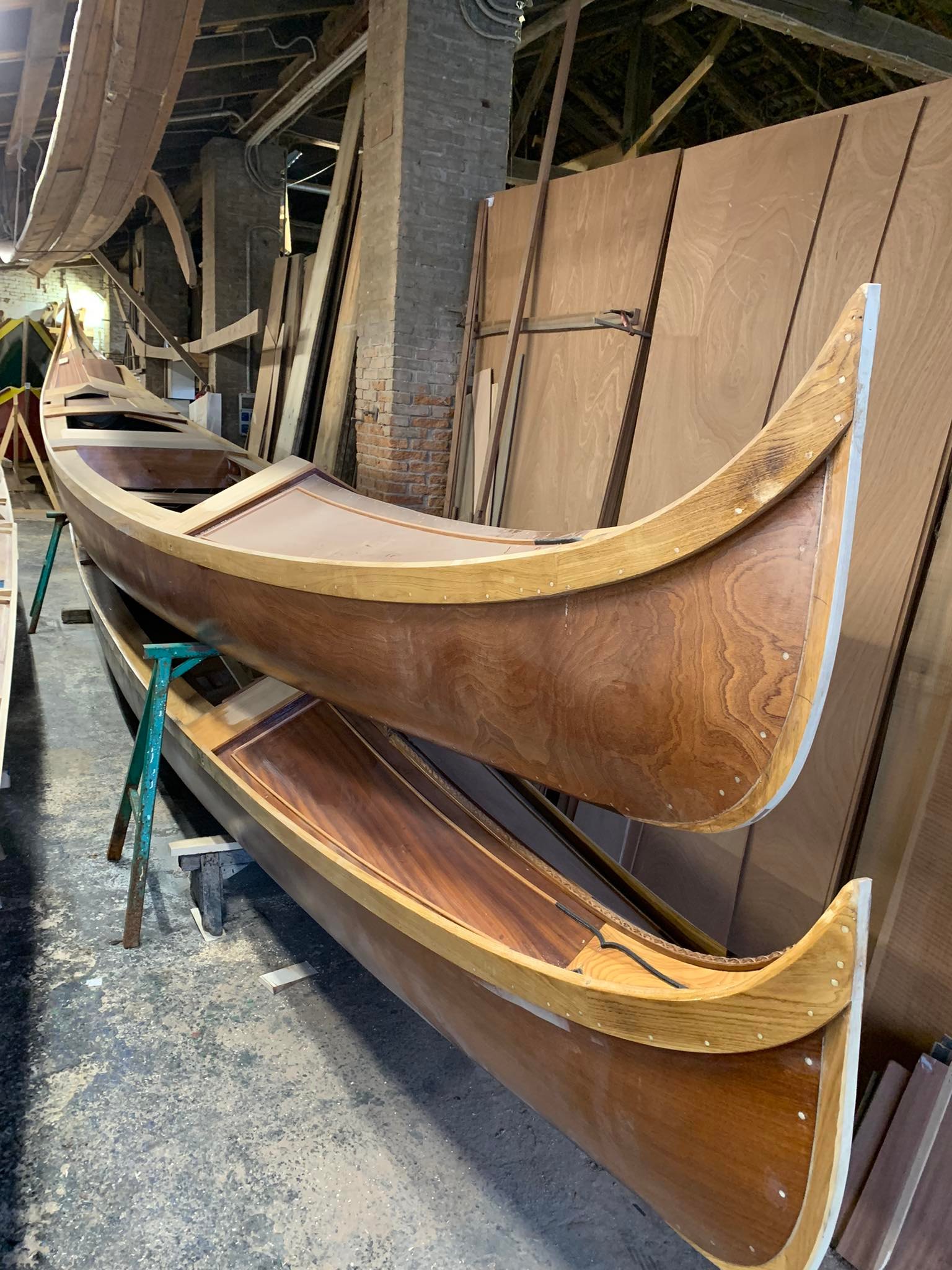
Belts were tightened, loans were taken,
money transfers were made…
And
two brand new gondolas were paid for.
Roberto
and I corresponded about various details:
What
kind of ferros?
What
color floorboards and seats?
Which
cavalli we wanted (the brass horses on the rails)
And
what custom carvings we wanted.
Our order with Saverio scaled up to include two more stern oars,
two forward oars,
and of course two stern forcolas and two forward forcolas.
I cannot overemphasize how gracious and patient Saverio and Roberto were with
us, and with the whole process – which was done between two continents and two
languages.
Both gentlemen, and their highly skilled staff are some of the best ambassadors that Venezia could ever have.
The
master craftsmen in both workshops labored hard to get everything complete.
Next we received some fresh images...of freshly-painted beautiful gondolas, out in front of Roberto's shop.


In the next phase I was emailing back and forth with Luca Niero of
Cutter SAS – hashing out the details of how the two elegant crescent-shaped
beauties would be shipped to Newport Beach.
I’d
seen this before when Tim and Tyson had two gondolas shipped from Venice back
in May of 2008.
(see
Two New Sunset Gondolas – Container)
And when I received photos from Saverio of the two gondolas nestled into their
container, it was a very similar packing arrangement – with one on the floor
with tires under the ends, and the other just above her, resting on large
sawhorses.

Because both ends of the boats rise up so high, the two were placed in an “X” arrangement so the rising tips wouldn’t touch each other during the voyage.

And WHAT A VOYAGE it turned out to be.

The
gondolas were loaded into their container in the Veneto, but then it was
trucked across the top of the boot of Italy to the port city of Genoa, where
the container was loaded onto a large cargo vessel.
Luca and the folks at Cutter SAS provided us with web-based information as to
the location of the ship, and we followed it’s progress.
The ship called at some other ports in southern Europe before crossing the
Atlantic. She docked in Cartahegna,
Colombia, and our container was offloaded there.
For the next three weeks it sat there.
My imagination was out of control.
Because the container was an “open-topped” model, with a tarp tied down
over the top, I wondered if anyone was investigating it, plundering it,
stashing contraband in it, flying in and laying eggs in it.
For all I knew, our container might arrive with a family of wild parrots living
inside, or with two feet of tropical rainwater sloshing around inside.
The imagination can sometimes really cause problems.
Eventually we were notified that the container was on another cargo ship and
heading up the west coast of Central America.
By the time the ship docked in Long Beach, our gondolas had been almost three months in transit.
To be continued…
Tuesday, March 15, 2022
Kyle and Kalev - Coming and Going
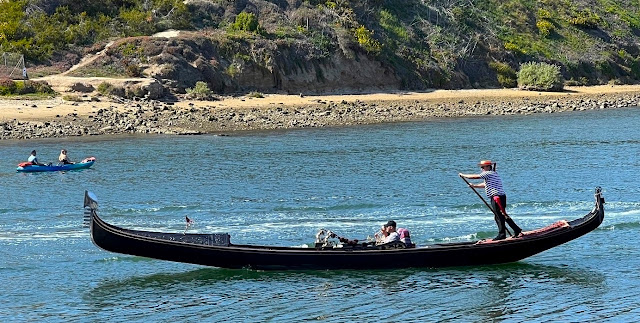
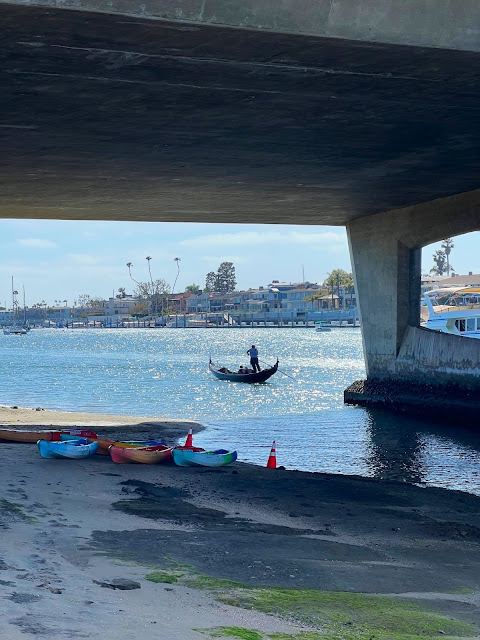

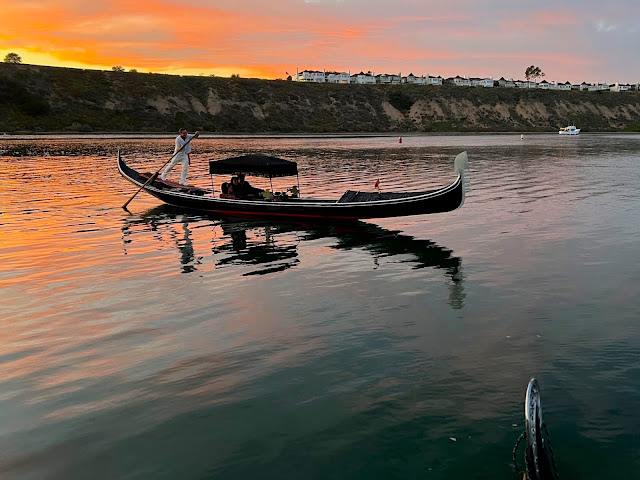
Meanwhile Kalev navigated wind and water with the canopy on the legendary gondola "Lucia".

Painted skies and calm surface conditions.

It's cruises like this where our clients don't want to
get out of the gondola.
Can't say I blame them.
Friday, February 11, 2022
Building Up to V-Day
Every year we spend a lot of time worrying about what the weather will look like on February 14th and the days leading up to it.
Some years it's dismal.
Some years it's something we can work with.
This year in Newport, the forecast is SO good,
I'm wondering where the hidden camera is.
I should apologize to my friends who live in places where there's snow.
But believe me folks, we pay for this weather dearly:
in taxes, and traffic, and governmental nonsense.
Don't even ASK me about gas prices.
And yet, for the last week or so,
I have witnessed several of our gondoliers out rowing in February...in shorts!
So at this point I'm getting an idea of what V-day must be like for my friends in Australia.
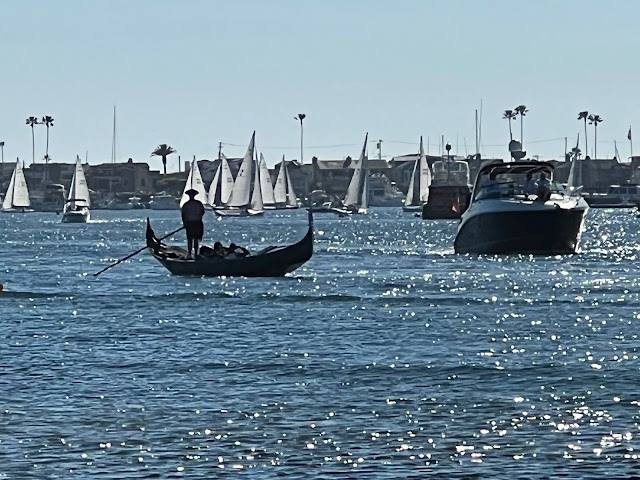
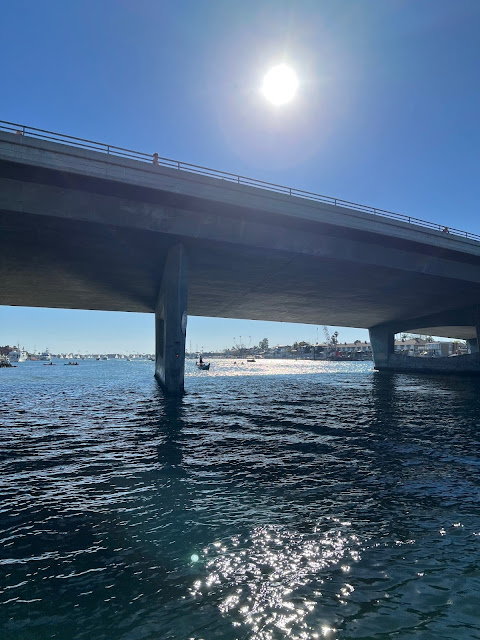
Here is a collection of shots I took from the docks as some of the gondoliers passed by.
 Brooks heads out with a happy couple.
Kyle rows in shorts in the sunshine.
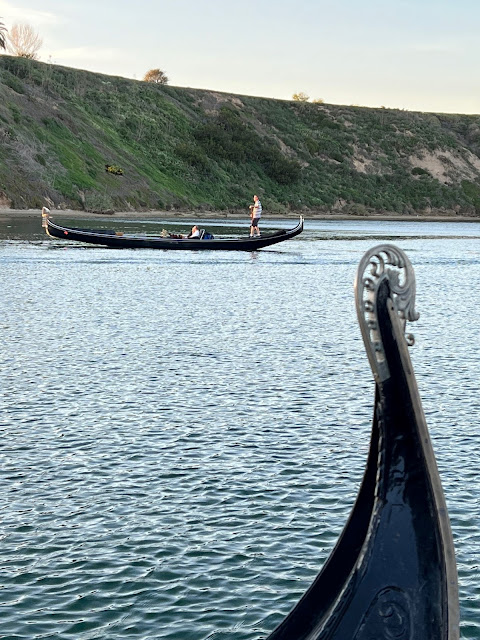

Harry departs as his passengers raise a toast.
 Brooks adjusts his sunglasses.
practice in the distance.

Sunday, January 30, 2022
Sunset in Venezia
photo by Alessandro Santini
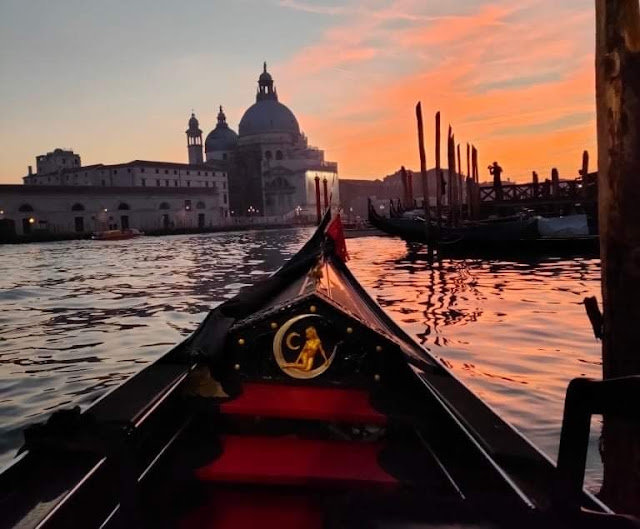
Yeah yeah, y'know...
Just another boring gondola sunset shot.
(Truth is, they never seem to get old)
My friend Alessandro sent me this great photo of a brilliant sunset in Venezia, with the iconic dome of the basilica di Santa Maria della Salute in the background.
I've been a fan of Alessandro's gondola
since she was launched in March of 2019
(see "Santini's Varo")
Big thanks to Alessandro for taking my desire to get to Venice...
and turbocharging it!